Showing posts with label Pattern design. Show all posts

Draw a continuous interlacing geometry motif.

Follow the step by step instructions to draw one of the most common, yet daunting patterns in Islamic Geometry. A continuous interlacing geometic piece. 


How to draw the 8 pointed star / khatim motif

In islamic art, the 8-pointed star motif is referred to as khatim or khatim-sulayman, meaning "seal of the prophets". Follow the step by step instructions to draw one of the most common motifs in islamic art.

Pattern design techniques: Adding complexity

Designing interesting and original patterns and motifs is an essential skill in textile and jewelry design. Let's see some simple and classic techniques that are taught in major design schools. These techniques will learn you how to start from a simple and ordinary shape and create a more complex and original design.


Coloring Pages that could inspire textile designers

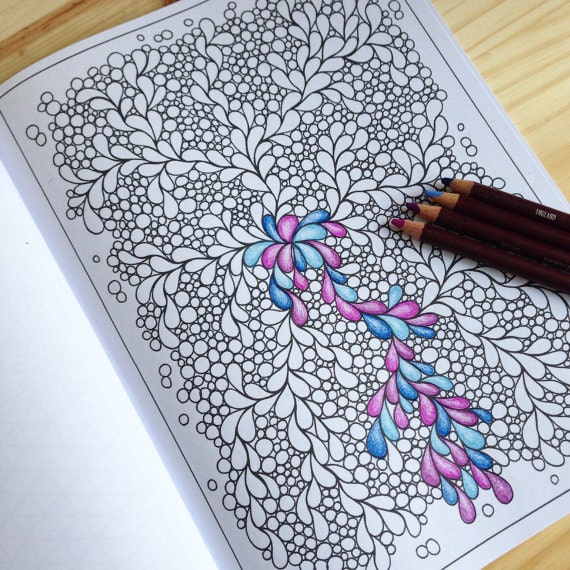
Coloring Pages and Coloring Books are already a classic trend for both kids and adults. Colorists claim that their work is not only addictive but also original and creative. It is true that many coloring pages are so well designed and colored in that they could easily be categorized as art pieces, worth to be framed and displayed. Both the illustrator of a coloring page and the colorist contribute to the final result. There are many black and white illustrations and designd that could be transfered to textile prints, stitching, applique etc. Take a look at some coloring pages that could probably inspire a textile artist and designer. 

Zentanlge inspired hand drawn page by JoArtyJo

Pattern development / Experimenting with tonal values

counted thread embroidery, modern craft, geometric patterns, geometry in art, modern hand-made, contemporary craft, textile art, geometric embroidery, modern embroidery
Tonal values / Hand embroidery 
Tone is how dark or light a color is. There are many ways to achieve tonal values in painting and sketching. But what about embroidery?
There are several methods to create the effect of tonal grading with thread and one of them is the method of pattern development.  


Asa-No-Ha pattern: Variations and experiments


Even a traditional pattern, which has been used for centuries in decorative arts, can still be further developed and change in order to give completely new and original results. Take for example the Asa-No-Ha pattern, a well-known and popular pattern in Japanese culture, and try the following variations. 

How to draw the Asa-No-Ha pattern

asa-no-ha, asanoha, sashiko, sashiko patterns, sashiko designs, sashiko ideas, japenese patterns

There are many ways to draw the Asa-No-pattern. The following technique is based on tesselation and suggest the same steps as in sashiko embroidery. 

Pattern design: drawing borders from repeating units


The basic mechanism of the pattern is the repetition of a single unit at equal intervals. In case of border design, the repetitions usually takes place either in the horizontal or in vertical direction.
The distance between the units is probably the strongest factor that affects the appearance of the pattern. 
To understand the role of the distance in pattern design, do the following exercise.

How to draw a meander border

meander border, meander, how to draw meander
A border can be described as a repeating pattern unit confined within fixed parallel lines. The pattern is repeated lengthwise only. A meander is a decorative border constructed from a continuous line. 

Designing an asymmetrical repeating pattern

fabric design, how to draw pattern, textile design, textile patterns,
Patterns most of the time are strictly symmetrical. You can however, design patterns that look asymmetrical and chaotic.

Pattern design using a grid of squares II


See how you can develop further the previous pattern (see here the process).

Pattern design using a grid of squares I

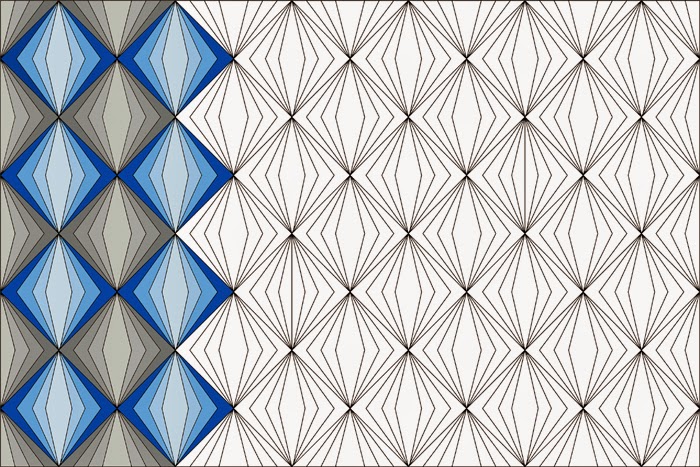
One of the most common techniques to draw a seamless pattern is by using a grid of squares. Follow the step by step procedure to draw a diamond shape pattern.

How to draw a seamless geometric pattern

Seamless patterns are usefull for textile and wallpaper designs. Let's see how you can draw an asymmetrical, repeating pattern made of intersecting ribbons.